Case Study
·2023
Petairu
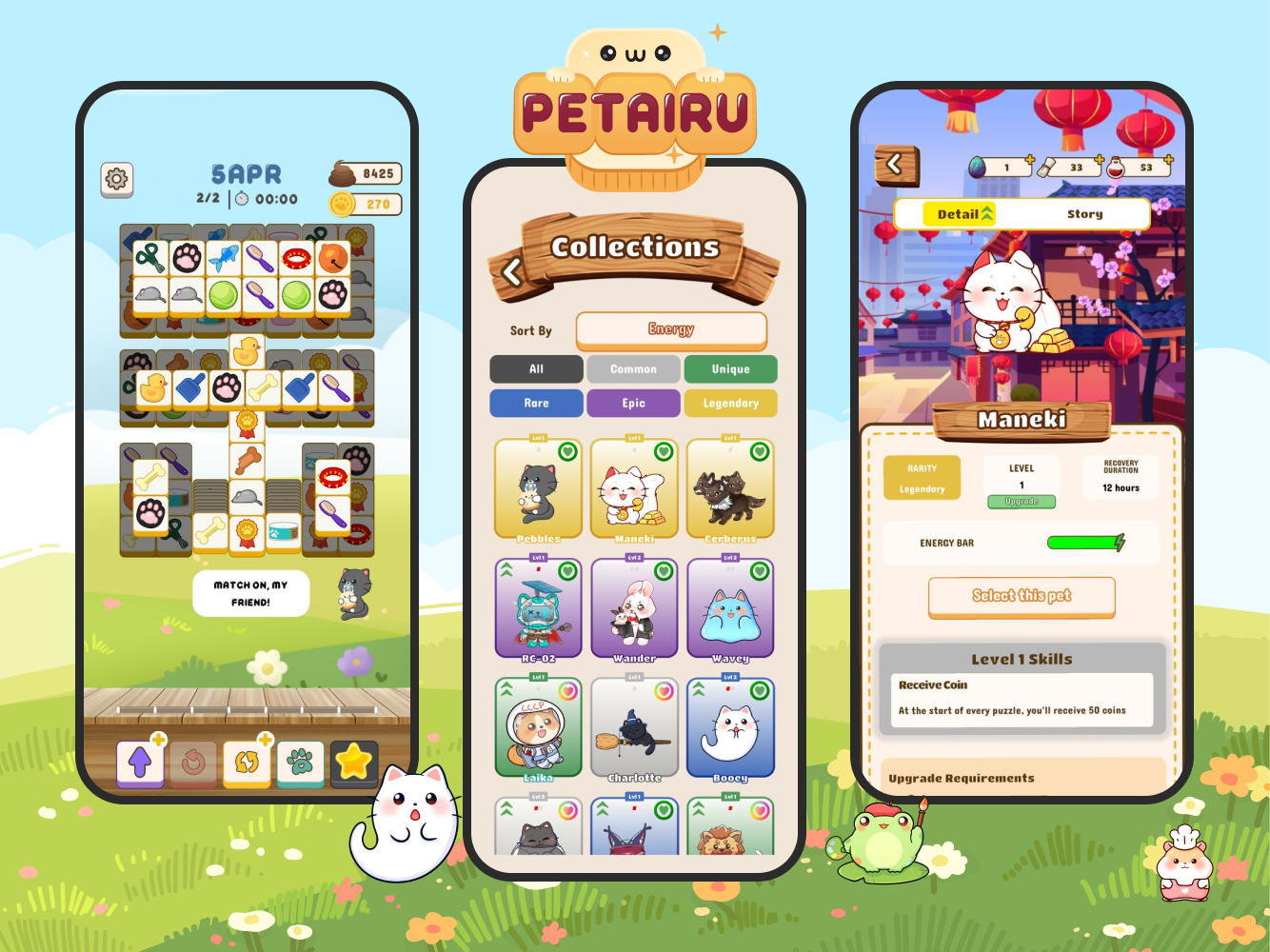
Engineering a Data-Driven Tile-Matching Puzzle Game With 5-Tier Pet Progression
Cross-platform Unity puzzle game with a NodeJS backend, JSON-based dynamic level system, dual-currency economy, admin-configurable skill trees, multi-tier competitive rankings, and a 5-rarity pet collection system — deployed on iOS and Android with Google Cloud infrastructure.
2
Mobile Platforms
30+
Collectible Pets
3
Game Modes
5
Pet Rarity Tiers
The Challenge
Building a puzzle game that sustains daily engagement beyond the first week
Casual puzzle games face a brutal retention cliff: most players churn within 7 days of install. The core challenge was designing a game engine sophisticated enough to generate fresh content daily, a progression system deep enough to sustain months of play, and a social layer compelling enough to drive organic re-engagement — all while keeping the moment-to-moment gameplay accessible to casual audiences.
Stale Content Problem
Traditional puzzle games ship static level packs that players exhaust quickly — leading to sharp retention drop-offs after the first week without fresh content to sustain daily engagement.
Flat Progression Curve
Without layered progression mechanics, players hit a ceiling fast. A single reward loop fails to motivate long-term play or encourage monetisation beyond initial installs.
Fragmented Social Experience
Players had no way to compare progress with friends or compete regionally — removing the social pressure and community-driven motivation that drives organic retention in casual games.
The Solution
Data-driven game engine with layered progression and live ops
Advisory Apps engineered a three-tier architecture: Unity C# game client → NodeJS REST API → MySQL database on Google Cloud. The backend manages level configuration, player state, economy balancing, leaderboard computation, and push notification scheduling — all configurable through an admin panel without requiring client app updates. Redis handles session caching and real-time leaderboard computation across millions of ranking entries.
System Architecture
The platform uses a layered architecture separating the Unity game client from server-side game logic. All game parameters — level configurations, skill costs, drop rates, event schedules — are server-authoritative, enabling live operations without app store resubmission.
iOS App
Unity • C#
Android App
Unity • C#
NodeJS REST API
Game Logic • Auth • Shop Transactions • Leaderboard Queries
MySQL
Player Data • Transactions
Cloud Storage
Level JSONs • Assets
CDN
Static Assets
Game Session Data Flow
Each game session follows a six-stage pipeline — from mode selection through level loading, tile rendering, match evaluation, and reward distribution. Level configurations are fetched as JSON from the server, allowing daily puzzle rotation without client patches.
Step 1
Player Taps Play
Selects game mode; daily puzzle auto-selected for returning players
Step 2
Level JSON Loaded
Server delivers level config: tile count, depth layers, shape layout
Step 3
Tile Engine Renders
Unity instantiates tile objects across depth layers with type assignments
Step 4
Player Matches Tiles
Three matching tiles selected, removed from deck, score updated
Step 5
Win/Loss Evaluated
Board clear = win; 7 slots filled = loss; Time Attack checks timer
Step 6
Rewards Distributed
Coins, pets, items, mission progress, ranking points awarded
Game Economy & Progression Systems
The game's economy is built on two interlocking systems: a 5-tier pet rarity distribution that controls collection depth, and a progressive reward decay curve that prevents economy inflation while rewarding early engagement.
Pet Rarity Distribution
Probability-weighted unlock system across 5 tiers
Item Drop Rate Decay
Progressive diminishing returns after consecutive wins
Pet Tier Comparison Matrix
| Tier | Drop Rate | Skills | Tiredness | Shop Price |
|---|---|---|---|---|
| Common | 40% | 1 | None | Low |
| Uncommon | 25% | 1 | 12 hrs | Medium |
| Rare | 20% | 1–2 | 12–24 hrs | High |
| Epic | 10% | 1–2 | 12–24 hrs | Very High |
| Legendary | 5% | 1–3 | 12–36 hrs | Premium |
Player Retention Pipeline
Six interlocking systems designed to deepen engagement at each stage of the player lifecycle
Daily Rewards
4-week rotating calendar with escalating prizes
Missions
12+ types with multi-tier progression goals
Daily Challenges
Unique task-based objectives refreshed every 24 hrs
Time Attack
2:30 competitive mode with 4 tile types
Special Offers
Starter, Founder, Holiday packs and bundles
Social Rankings
Friend, country, and global leaderboards
Deployment Infrastructure
The backend runs on Google Cloud Platform with managed services for database, caching, and storage — minimising operational overhead while maintaining high availability for a global player base.
Mobile Players
iOS • Android
Google Cloud Platform
Cloud Load Balancer
Compute Engine
NodeJS Instances • Auto-scaling
Cloud SQL
MySQL • Player Data
Memorystore
Redis • Queue • Cache
Cloud Storage
Level JSONs • Media
Facebook OAuth
FCM / APNs
App Store / Play Store
JSON-Based Dynamic Level Engine
A custom Level Designer tool exports tile arrangements as JSON — loaded at runtime so new puzzles deploy without app updates. Daily shape rotation keeps the board layout fresh every 24 hours.
Multi-Layer Pet Progression
Five rarity tiers (Common through Legendary) with per-pet unique skills, leveling requirements, tiredness cooldowns, and admin-configurable stats — creating deep collection and upgrade loops.
Social Rankings & Competitive Loops
Facebook OAuth integration powers friend leaderboards alongside global, monthly, and country-level rankings — with team-based country competitions adding a cooperative dimension.
Implementation Timeline
Phase 1
Core Game Engine
Phase 2
Economy & Shop
Phase 3
Social & Rankings
Phase 4
Retention & Live Ops
Methodology
Game design document to live operations
Development followed a GDD-first methodology: every mechanic, probability curve, and economy variable was defined in a comprehensive Game Design Document before a single line of code was written. This enabled parallel development of the Unity client and NodeJS backend with shared JSON schema contracts, and allowed the team to tune the live economy through an admin panel without app store resubmissions.
Game Design Document
Defined tile-matching mechanics, pet rarity distributions, currency economy, reward curves, and all skill interactions in a comprehensive GDD before writing any code.
Parallel Client + Backend
Unity game client and NodeJS API developed concurrently — shared JSON schema contracts ensured level data, player state, and shop transactions integrated seamlessly.
Data-Driven Tuning
Admin panel enabled real-time adjustment of drop rates, skill costs, level difficulty, and reward curves without deploying a client update to app stores.
Soft Launch & Iterate
Staged regional launch with analytics instrumentation — monitored session length, retention cohorts, and monetisation funnels to tune economy before wide release.
Key Features Delivered
Custom Level Designer Tool
Proprietary editor for arranging 240–450 tiles across 20–40 depth layers, exporting JSON configurations loaded at runtime without client updates.
Dual-Currency Economy
Coins (purchasable via IAP) and Poop (earned through gameplay with 30%/70% drop odds) — each currency gates different skill tiers to balance free and paying player experiences.
Admin-Configurable Skill System
Three free skills (Move Up, Undo, Shuffle) and three premium skills (Peek, Clean Up, Shift) with admin-tunable costs, cooldowns, and availability — plus per-pet unique abilities.
Progressive Reward Algorithm
New pet probability decays from 100% to 50% after 10 acquisitions; item drop rates decay from 100% to 3% after 6 wins — preventing economy inflation while maintaining early excitement.
Multi-Tier Ranking Engine
Global (all-time + monthly), friend (social login), and country (individual + team) leaderboards with Redis-cached ranking computation for sub-100ms response times.
Retention Module Suite
4-week rotating daily rewards, 12+ mission types with multi-tier progression, daily challenges with unique objectives, and Time Attack mode with competitive constraints.
The Results
Measurable impact across game systems
100%
Server-Side Content Control
New levels, events, and balancing changes deploy without requiring app store submissions or client updates.
3
Distinct Game Modes
Standard Daily Puzzle, Time Attack, and Daily Challenge provide varied daily engagement touchpoints.
30+
Collectible Pets Across 5 Tiers
Deep collection system with per-pet unique skills, leveling curves, and rarity-based stat variations.
4
Ranking Dimensions
Global, monthly, friends, and country rankings create competitive loops across different social contexts.
Modules Used
Built with production-ready modules
This project leverages our library of battle-tested modules — each independently scoped, tested, and deployed across multiple client projects.

Gamification Engine
Badges, leaderboards, streaks, challenges, and XP systems to drive user engagement

Payment Gateway Hub
Unified payment abstraction over FPX, credit cards, e-wallets, and regional payment methods

Push Notification Engine
Multi-channel push notifications with segmentation, scheduling, and analytics

User Management
Unified user profiles, role-based access, and secure authentication

Single Sign-On (SSO)
SAML 2.0 and OAuth 2.0 federation with Google, Microsoft, Apple, and custom identity providers

Membership & Points System
Tiered loyalty programs with point accrual, redemption, and member benefits

Referral & Affiliate System
Shareable referral links with reward tiers, conversion tracking, and payout management

Dashboard & Analytics Builder
Drag-and-drop dashboard with charts, KPIs, real-time widgets, and role-based views

In-App Notification Center
Bell-icon notification feed with read/unread, categories, deep links, and preferences
Conclusion
Technical depth meets casual accessibility
Petairu demonstrates that casual puzzle games can be built on sophisticated engineering foundations without sacrificing accessibility. The JSON-based level engine, dual-currency economy, 5-tier pet progression, and multi-dimensional ranking system combine to create a game that is simple to pick up but deep enough to sustain months of engagement — all driven by a server-authoritative architecture that enables live operations without app store friction.
The admin-configurable approach — where skill costs, drop rates, level configurations, and event schedules are all tunable from a dashboard — transformed the game from a static product into a living platform. Combined with daily content rotation, progressive reward curves, and social ranking pressure, Petairu achieves the retention depth typically reserved for mid-core games while maintaining the one-tap simplicity that casual audiences demand.
Future Outlook
- Seasonal event framework with time-limited pets and themed level packs
- Real-time multiplayer puzzle mode with WebSocket-driven synchronisation
- Machine-learning difficulty adjustment based on individual player performance patterns
Services Used
Capabilities behind this project



Want similar results for your business?
Let's discuss how we can build a custom solution tailored to your needs.
Get a Free Consultation