Case Study
·March 2024
Perodua
Digitising Sales Operations Across 225+ Dealerships
Enterprise mobile platform integrated with Perodua's centralised Oracle database — serving 225+ dealerships and 358,000+ annual vehicle sales — built using Agile methodology with SIT, UAT, QA gates and phased module releases.
57%
Manual Work Reduction
6
Development Phases
10K+
App Downloads
225+
Dealers Served
The Challenge
Connecting 225+ dealerships to a single Oracle database
Perodua's IT infrastructure centres on a centralised Oracle database that manages dealer records, vehicle inventory, customer data, and sales transactions across all 225+ nationwide branches. Any new system must integrate directly with this Oracle instance — no data duplication, no shadow databases. The mobile platform had to read and write to Oracle in near real-time while maintaining data integrity across concurrent users at multiple branches.
Unverified Agents
No reliable method for customers to confirm they are dealing with a legitimate Perodua sales advisor.
Manual Data Entry
Handwritten forms and manual IC entry caused frequent errors and slow onboarding across 225+ branches.
No Retention System
No structured way to follow up with 358,000+ annual customers after purchase.
The Solution
Three-tier architecture built for enterprise scale
Advisory Apps architected a three-tier system: Flutter mobile client → Node.js API middleware → Perodua centralised Oracle database. The middleware layer handles Oracle connection pooling, query batching, data transformation between Oracle's relational schema and the mobile app's JSON payloads, and caching frequently-accessed reference data.
Integration Architecture
The mobile platform integrates with Perodua's existing Oracle database — the same database already connected to the web-based SA system. As adoption grows, more transactions are shifting from the web interface to mobile.
Web SA System
Existing • Legacy
Declining usage
Mobile SA App
Flutter • New
Growing adoption ↑
Node.js API Middleware
Connection pooling • Query batching • Data transform • Caching
Perodua Centralised Oracle Database
Single source of truth — dealers, vehicles, customers, transactions
Transaction Flow
How a typical sales transaction flows from the mobile app through to the Oracle database — replacing the legacy web-based workflow with a faster, mobile-first process.
Step 1
SA Opens App
Sales advisor launches Flutter mobile app & authenticates
Step 2
QR / eKYC Scan
Verify identity via daily QR code or scan customer IC with OCR
Step 3
API Middleware
Node.js validates, transforms JSON → Oracle schema & manages connection pool
Step 4
Oracle DB Write
Transaction committed to centralised Oracle — visible across all 225+ branches
Step 5
Synced Nationwide
Retention engine triggers follow-ups, data synced to web SA in real-time
Transaction Channel Shift
Dealers increasingly prefer mobile for day-to-day transactions
Daily QR Verification
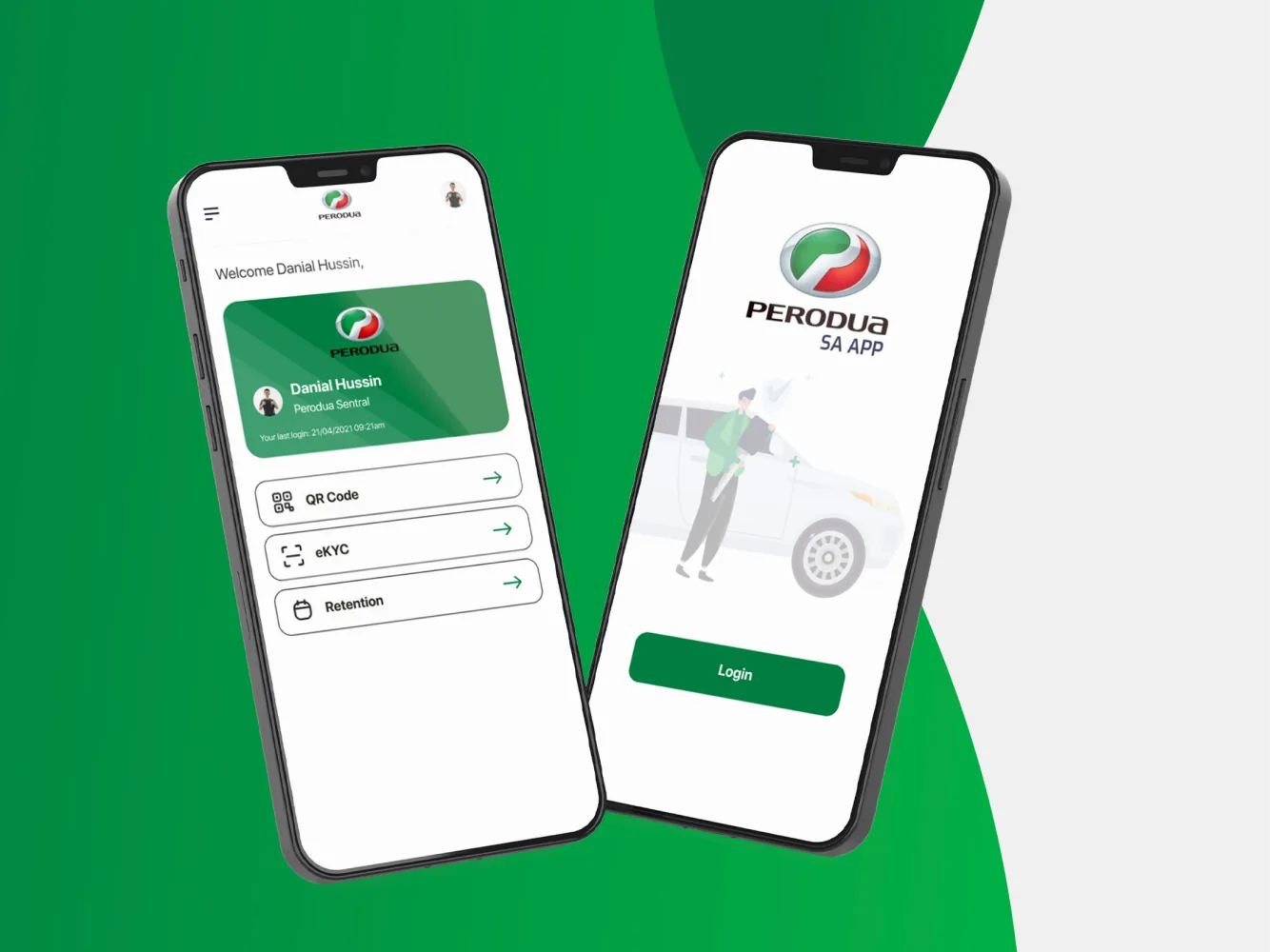
Each sales advisor receives a unique QR code updated daily — customers scan to instantly verify agent legitimacy.
eKYC Document Scanning
OCR technology scans IC and passport documents to auto-populate registration forms, eliminating manual input errors.
Automated Retention Engine
Scheduled follow-up calls, WhatsApp messages, birthday wishes, post-delivery check-ins, and insurance renewal reminders.
Implementation Timeline
Phase 1
Agent Verification
Phase 2
eKYC Onboarding
Phase 3
Retention Engine
Phase 4
Sales Toolkit
Phase 5
e-Vehicle Ordering
Phase 6
Bank Integration
Methodology
Agile SDLC with strict quality gates
The project followed strict Agile methodology with phased module releases. Each of the six phases was independently scoped, developed in 2-week sprints, and passed through a full testing pipeline before production deployment.
Discovery & Architecture
Oracle DB schema analysis, API contract design, infrastructure capacity planning with Perodua IT team.
Sprint Development
2-week Agile sprints with feature branches, code review, and unit test coverage per module.
SIT & UAT
System Integration Testing against Oracle, then User Acceptance Testing with live branch staff.
QA & Production
Regression suite, security audit, pilot branch rollout, then nationwide deployment.
Key Features Delivered
Oracle Database Integration
Direct read/write to Perodua's centralised Oracle DB via custom Node.js middleware with connection pooling and transaction isolation.
Daily-Rotating QR Verification
Server-generated JWT-based QR tokens rotated daily, validated against the Oracle SA registry in real-time.
eKYC Document Scanning
OCR engine with auto-population pipeline writing directly to Oracle customer records.
Automated Retention Engine
Scheduled jobs querying Oracle for customer lifecycle events triggering WhatsApp and push notifications.
CDN-Cached Sales Toolkit
Brochures, price lists, and videos distributed via CDN with Oracle catalog sync and offline-first caching.
e-Vehicle Ordering System
End-to-end digital ordering flow — booking, test drive scheduling, e-signature capture, in-app document upload by sales agents, and order submission straight into Perodua's Oracle fulfillment pipeline.
Malaysian Bank Integration
Direct integration with major Malaysian banks for hire-purchase loan application, approval status, and disbursement — replacing paper-based finance flows with a fully digital credit journey.
Agile SDLC Pipeline
Every module passed through SIT, UAT, and QA before production deployment.
The Results
Measurable impact across the dealer network
57%
Reduction in Manual Processing
Sales advisors spend less than half the time on paperwork compared to before.
10,000+
Play Store Downloads
Rapid adoption across the nationwide dealer network.
225+
Dealer Branches Connected
All branches reading and writing to a single Oracle source of truth.
~0%
Data Entry Errors
Near-zero manual errors via eKYC automation and OCR.
Modules Used
Built with production-ready modules
This project leverages our library of battle-tested modules — each independently scoped, tested, and deployed across multiple client projects.

QR Code Management
Generate, customize, and track QR codes with dynamic URLs, scan analytics, and bulk creation

KYC & Identity Verification
Document upload, OCR extraction, liveness check, and manual review workflows for onboarding

Push Notification Engine
Multi-channel push notifications with segmentation, scheduling, and analytics

CRM & Lead Management
Contact database, deal pipeline, activity logging, follow-up reminders, and sales reports

User Management
Unified user profiles, role-based access, and secure authentication

Activity & Audit Log
Immutable system-wide activity logging with user attribution, filtering, and compliance exports
Conclusion
Enterprise-grade mobile, delivered right
The Perodua SA platform demonstrates enterprise-grade mobile development done right: direct Oracle database integration, strict Agile methodology with SIT/UAT/QA gates, and phased module releases that delivered value incrementally without risking the client's core data infrastructure. Each phase was a complete delivery cycle — scoped, built, integration-tested against Oracle, user-validated at pilot branches, and deployed to production.
The cumulative result: a 57% reduction in manual sales process work, near-zero data entry errors through eKYC automation, and a unified digital platform across 225+ dealer branches — all reading from and writing to Perodua's single source of truth: their centralised Oracle database.
Future Outlook
- B2C customer-facing features for direct buyer engagement
- Additional Oracle modules for service booking and parts ordering
- AI-powered sales prediction and lead scoring integration



Want similar results for your business?
Let's discuss how we can build a custom solution tailored to your needs.
Get a Free Consultation